6 Special notes
6.1 Overview
This section lists notes, which apply the specific groups of data products. The notes are referenced in the readme pages.
6.2 Note on spatially heterogeneous trace gases
Short-lived reactive trace gases with points sources on the surface are usually very heterogeneous both temporally and spatially. An example for this is NO2, where the surface concentration and even column amounts can very over a distance of meters and a time of seconds only.
For these species parameters such as the sampled air mass and the EGL of the measurements need to be considered when the data are compared to other measurements, e.g. surface in-situ data or satellite data (see also Chapter 4). E.g. at solar ZA = 60° and an (true) effective height of the NO2 of 4.2 km, the effective location is shifted for a distance of 7.3 km in the direction of the sun relative to the location of the instrument (Equation 4.4).
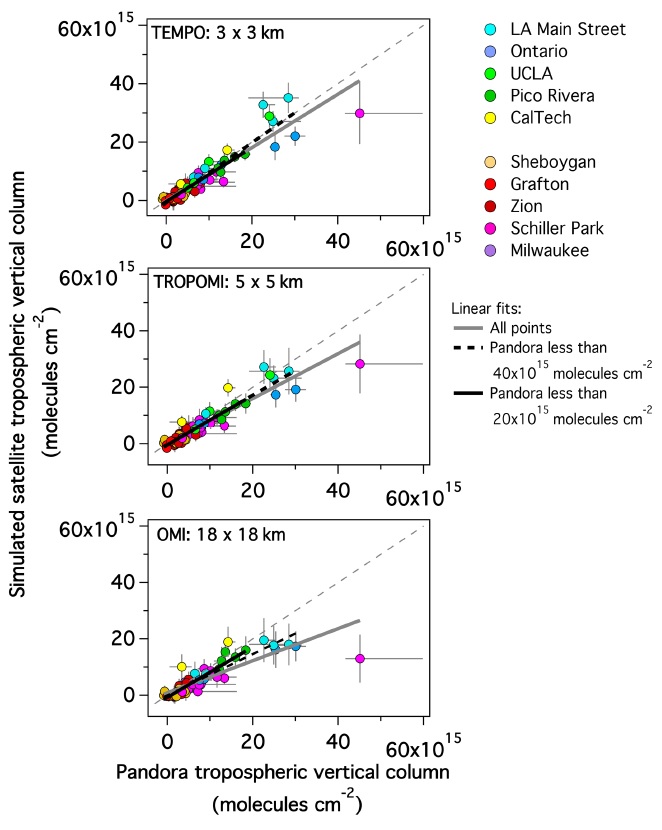
It turns out that for such gases the different viewing geometry between the PGN observations and satellite data is most often the main driver for possible differences between these products. The magnitude of this difference typically grows with the size of the satellite footprint and the pollution level at the location. An excellent description of this can be found in Judd et al. (2019), from which Figure 6.1 is taken.
Past studies have shown, that the satellite data being a spatial average over the footprint compare better to a temporal average from the ground measurements than to the instantaneous observation exactly at the satellite’s overpass time (see e.g. Cede et al. (2004)). Therefore it may be useful to build such a temporal average using the formula given in Equation 5.2 when doing satellite to ground comparisons.
6.3 Note on retrievals in the short UV range
Pandora data retrieved in the short UV range (below 350 nm) are affected by spectral and spatial stray light. The aspects described below should be known when using PGN data products from this wavelength range.
Spectral stray light: since the intensity of the solar light increases significantly from the UV into the visible spectral range, spectral stray light is affecting significantly the measurements in the short UV range. A dedicated correction correction is applied on the PGN spectra only for processor versions > 1.8. Hence a residual effect is likely, if no or just an insufficient stray light calibration is performed on an instrument. This causes e.g. total ozone columns to be biased low starting at solar ZA=70° deg and sometimes even at smaller values.
Spatial stray light: the fraction of diffuse light entering the instrument in addition to the direct beam for direct sun or moon observations increases with the (solar or lunar) zenith angle and the amount of aerosols in the atmosphere. Since the direct algorithm is based on the assumption that only direct light is measured, a systematic error in the data is introduced, which grows with this “diffuse fraction”. This causes e.g. total ozone columns to be biased low. However BlickP does currently not take this effect into account at all.
To “capture” this stray light problem, the AMF limits in such “short-UV” retrievals are set to lower values compared to retrieval at from higher wavelength regions.
6.4 Note on weak absorbers
We consider a trace gas a weak absorber, if the largest differential vertical optical depth is about 1e-3 or even below for typical column amounts. Such trace gases are more sensitive to measurement uncertainty than the more absorbing ones. This is described here, separately for direct sun observations and sky observations.
6.4.1 Weak absorbers in direct observation
Direct (sun or moon) observations have one major weakness with respect to spectral fitting compared to sky observations. The direct beam is quasi-parallel with a very small divergence of 0.5°, while the sky radiance is rather homogeneous over the FOV of the system. Therefore the direct observation is extremely sensitive to the exact pointing of the instrument. When two direct measurements are made with a pointing difference relative to the source (e.g. the sun’s direction) even below 0.1°, the spectra typically show a difference, which can significantly affect the column retrievals of weak absorbers. Here we call this spectral difference an “unwanted spectral signal” (USS). In order to minimize this effect, the Pandora spectrometer system uses a wedged entrance window and a diffuser in the filterhweel, when measuring in direct sun mode (see e.g. Tiefengraber and Cede (2016)). Nevertheless the USS still exists, more for some instrument than for others, and we are still investigating options to further reduce it.
At this moment, BlickP cannot identify data affected by this USS, hence this does not show up in the uncertainties, not does it trigger some DQ thresholds. Therefore the user should be aware, that it is possible, that the retrieved columns amounts for weak absorbers have temporary systematic issues.
6.4.2 Weak absorbers in sky observation
While sky observations usually do not suffer from an USS as described in the previous section, they typically suffer from a low SNR. The amount of sky light reaching the instrument is simply not large enough to obtain a high SNR with a system like Pandora that uses an uncooled detector and small optics. Therefore the user should be aware that Profile retrievals for weak absorbers may be driven by the independent uncertainty (noise). In order to reduce the noise one can average the data as described in Section 5.2.